• Skip to primary navigation
  • Skip to main content
  • Skip to primary sidebar

Just One Reason

وَمَا خَلَقْتُ الْجِنَّ وَالإِنسَ إِلاَّ لِيَعْبُدُونِ [Qur'an, 51:56]

  • Home
  • About
  • Books
  • Videos
  • Contact

Politics

US Aid to Israel: How Much is Your Share?

February 21, 2010 By Anonymous Leave a Comment

From: www.aidtoisrael.org

How Much Military Aid to Israel…

…Do You Provide?

africaaiddone2

How Much Military Aid to Israel…
…Do You Provide?
Between 2009-2018, the United States is scheduled to give Israel–the largest recipient of U.S. aid–$30 billion in military aid. Through its illegal 42-year military occupation of the Palestinian West Bank, East Jerusalem, and Gaza Strip, Israel misuses U.S. weapons in violation of U.S. law to kill and injure Palestinian civilians, destroy Palestinian civilian infrastructure, blockade the Gaza Strip, and build illegal settlements in West Bank and East Jerusalem.
How much of this total will your community provide?  Is this a good use of your tax dollars? What else could your taxes be used for in your community?  Find out on the interactive map below.

Between 2009-2018, the United States is scheduled to give Israel–the largest recipient of U.S. aid–$30 billion in military aid. Through its illegal 42-year military occupation of the Palestinian West Bank, East Jerusalem, and Gaza Strip, Israel misuses U.S. weapons in violation of U.S. law to kill and injure Palestinian civilians, destroy Palestinian civilian infrastructure, blockade the Gaza Strip, and build illegal settlements in West Bank and East Jerusalem.

How much of this total will your community provide?  Is this a good use of your tax dollars? What else could your taxes be used for in your community?  Find out on thid interactive map:

Aid To Israel

  • Simply click on your state to find out how much it’s 2009-2018 budget is going directly to provide military aid to the Israeli occupation of Palestine.
  • You can even search data for your county, congressional district, and city by clicking on “US Regions” on the left (next to the up arrow).

This may seem especially infuriating right now; it being tax season and all… Want to know how much the average tax payer will pay in military aid to Israel in 2010? Well, if we take Obama’s FY2011 budget request of $3 billion in military aid to Israel and divide it by the 156,297,000 individual tax filings reported to the IRS, the number is $19.19. That’s $19.19 in military aid that you will be paying to Israel this year. So get your checkbooks ready!

And this is just military aid; this doesn’t include economic grants, immigrant grants, schools and hospital grants, and other aid. That means, this year $19.19 of every American tax payer’s income will directly fund and aid in the brutal, deadly, military occupation of Palestine.

Now the question is…

…what are we going to do about it?

Filed Under: Palestine, Politics Tagged With: boycott, divestment, israel, obama, Palestine, sanctions, war

“Killing the Indian in the Child”

February 13, 2010 By Anonymous 1 Comment


LostToGenocide

Last night we attended a REEL Activism event at Bloor St. United Church where we watched a short film and heard a talk/discussion with activist Margaret Sumadh, member of Christian Peacemaker Teams, about the impact of Canadian residential schools on Aboriginal survivors. Being an American-born citizen who only moved to Canada just over one year ago, there’s so much of this country’s history that I’m completely unaware of. I must say, having only recently learned about this dark legacy of Canada’s not-so-distant past, I was shocked, angered, and appalled at what I saw and heard last night; these feelings were multiplied by the fact that in the audience with us were survivors and children of survivors of these awful schools, meant to “kill the Indian in the child.”

The Canadian Indian residential school system, founded in the 19th century, was created for the sole purpose of forcing the assimilation of the Aboriginal (First Nations) peoples into western, “civilized” Canadian society. Basically, this system of schools, which was jointly-controlled by the churches and the federal government, believed that indigenous children needed to be “civilized” in order to assimilate into modern, western, Canadian society. They aimed to achieve this goal by forcibly taking young children (as young as 6 years old) from their homes and placing them in residential schools until they were at least 16 years of age; supposedly, they were to return to their homes during the summers, but many didn’t see their families for years at a time.

Residential School

The children in these schools were forced to learn English, dress like their Canadian counterparts, and convert to Christianity. They were prohibited from speaking their native languages and subjected to corporal punishment if they spoke anything other than English and French or were caught practicing non-Christian faiths; ultimately leading to the cultural genocide of an entire people. Students were also forced into manual labour in order to maintain the already severely underfunded facilities.


Map of Residential Schools in Canada

During the 1950’s there were 76 residential schools in all but three provinces in Canada. By 1969, the federal government had taken sole control of the residential school system, and by the 1990’s it was finally revealed that several students were subjected to severe physical, mental, and sexual abuse by teachers and other school officials. The last residential school in Canada was finally closed down in 1996. Several court cases led to monetary payments to survivors from the federal government, and in 2008 the Canadian government issued a formal apology to the survivors, their families, and the entire First Nations community. But was this apology too little too late?

Of course it was! An entire people’s culture, traditions, their very identity was stolen from them, wiped away from their mental history books! That doesn’t even include the hundreds of children who died while enrolled in these schools. When these young children were sent back home after they’d been “civilized” they were like strangers in their own homes. They had been changed into completely different people with no connections to their families, their culture, or their heritage. They had lost all ability to speak their native language, no doubt breaking the communication and traditional knowledge sharing between parents and their children. These residential schools had ultimately broken the very fabric of their society, and purposely so.


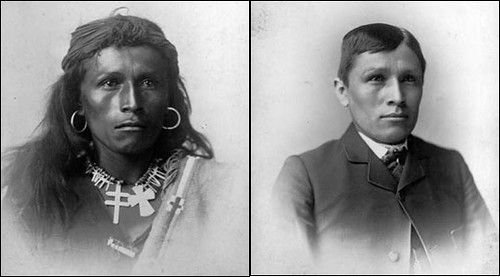
Thomas Moore before and after residential school


Tom Torlino before and after residential school


Furthermore, these schools also had grave psychological effects on the Native youth. At these schools, from a very tender age, children were taught that their native culture and identity was inferior and not worth preserving. They were told they were a dirty, uncivilized, backwards people and that in order to function in society they had to denounce everything they knew to be true about themselves and adopt a new, bright, forward-thinking identity, ie: European/Western way of life. Youth ultimately were taught to resent their culture and heritage and to embrace the European outlook, culture and belief system.

Residential School Students

Today, Aboriginal people want recognition of what was done to their communities as a result of the residential school system. They have asked for and received official apologies from the Anglican, United, and Catholic churches in Canada, which operated the residential schools. But there is still a long and painful road ahead before the First Nations people receive the reparations and justice they deserve and so badly need. Unfortunately, this information (like much of North America’s dirty past) is not taught in public schools, so it’s completely absent from peoples’ consciousness. Nor is this given anywhere near the amount of necessary media attention it deserves; but then again, what important social and political topics are?

But the truth of the matter is that the issue of genocide of the Aboriginal people is not something that happened in the past and is now over; no, these people are still fighting and will continue to fight for their land rights, their sovereignty, and their natural resources which to this day, are still being stolen, polluted, or in one way or another, colonized for Euro-Canadian imperialistic gains.

To learn more about this untold story of the genocide of the Aboriginal peoples, please visit Hidden From History: The Canadian Holocaust.

Below is the trailer of a full-length award-winning documentary on the planned extermination and genocide of the Aboriginal people by the churches and state in Canada. The film is told through the eyes of survivors of this genocide, and a former minister who tried to hold his church accountable for its crimes. The full-length film can be seen here: Unrepentant.


[youtube j8HB5cbKHDU Unrepentant]

Tomorrow, February 14th in Toronto, we will be marching in the 5th Annual Rally for our Missing Sisters in solidarity with and to commemorate the over 500 Indigenous women who have been murdered or gone missing over the past 30 years. We’re demonstrating against the complicity of the state in the ongoing genocide of Indigenous women and the impunity of state institutions and actors (police, RCMP, coroners’ offices and the courts) that prevents justice for all Indigenous Peoples. Stay tuned for a report and pictures from that event!

Finally, the REEL Activism event that took place last night is a monthly event put on by the church. Next month’s REEL Activism will feature yours truly in a Report back from the Gaza Freedom March in Cairo. The event announcement can be seen here: Gaza Freedom March: A REEL Activism Event. I will be creating and showing a short film about the events that took place in Cairo and give a talk about the political implications of the movement. Stay tuned for more info on that as well!

Filed Under: History, Politics Tagged With: aboriginal, apartheid, canada, extermination, first nations, genocide, residential schools

Obama on Palestine: A Tale of Two Speeches (VIDEO)

January 31, 2010 By Anonymous 2 Comments

1252042794obama_flags_us_israel


This is a brief somewhat lengthy synopsis of how Barack Obama handled the issue of Palestine during two speeches he gave last week: The State of the Union address on Jan. 27 and a town-hall meeting in Tampa on Jan. 28.

The State of the Union address

The energy was in the air once again on Wednesday night, as America’s first black president gave yet another historic speech: the State of the Union address, his first one ever (honestly, last year’s doesn’t count; he was barely president for less than a month!). Tensions were high as many Americans were reminded once again of where exactly the country stands in regards to the issues that affect them and their families the most: the economy, health care, one two three full-fledged wars in the middle-east. So I sat down to watch the State of the Union, for the first time on the other side of the border, in Canada.  I caught it on the White House’s website, which had a convenient little Facebook app right on the page so users could send out instant updates about their reactions to the speech…I don’t have to tell you that I used that thing to it’s full capacity 🙂

So what was in this oh-so-historic, can’t-be-missed address? Well, aside from the redundant references to the mess that he inherited when getting into office, the wonderful job he’s done in killing more “terrorists” than Bush did in 2008 (his words, not mine), and the fact that he’s not really interested in punishing the banks but more interested in “protecting the economy” (whatever that means), Obama and his two wingmen, Biden and Pelosi, made it very clear that this entire sham of a speech was just one big performance for the masses. If you watched the 70-minute speech, it was very hard to ignore the obviously staged laughter, applause, laughter, applause, applause, applause, laughter…it was like clock-work. Honestly, it felt like everything was one big inside joke for all those in attendance; well, except for the supreme court justices seated right up at the front. They didn’t laugh at or clap for anything; probably because they’re under a lot of heat for their recent decision to overturn a ban on direct corporate spending on campaigns….yep, as of now, corporations officially have the same freedoms afforded to individual persons in that sense. So say hello to the new sponsor of Candidate A’s 2012 election campaign: Lockheed Martin and Candidate B’s election campaign: The Rand Coporation!

All I got from the speech was more wars, America has to be #1 (at what, we don’t really know), and a cruel reminder of all the broken campaign promises made by Obama in the run-up to his election:

  1. Repeal the Patriot Act? Nope

  2. Close Guantanamo? Nope
  3. Post all new legislation online for 5 days before its acted upon? Nope
  4. Pull all soldiers out of Iraq? Note even close.

There’s many more, but I don’t want to bore anger you even more. Now let’s get to the good stuff: Palestine! What did Mr. Commander-in-Chief have to say about the most blatantly neglected issue over this past year? First, let me explain why exactly I’m interested in hearing his input on this issue. Last year when Israel was bombing the hell out of Gaza for over three weeks straight, newly elected president, Barack Obama, surprisingly had NOTHING to say on the matter! Surprising because if any one is going to say something about anything, it’s his eloquent majesty himself. So this was infuriating as is. In his own defence, he claimed that since technically he hadn’t taken office yet, he didn’t feel it was appropriate to make an official statement on the issue so as not to “confuse” the country…uhh yeah, ok?!?!

So Wednesday night was like a movie premier for me, with popcorn and all! He ran through the usual (or expected) suspects: Iran? – check… Haiti? – check… “Terrorists”? – check… even “Don’t ask, don’t tell” – check…. Palestine? ***silence***. Absolutely nothing! Not even a single breath about Palestine, Gaza, or any of the atrocities being committed in the region for not just the past year, but decades and decades. He didn’t even talk about Afghanistan! or even Pakistan! That can only mean one of two things: 1) either he’s afraid to talk about them because of how obviously wrong his policies are in regards to those issues, or 2) he’s failing so badly in all three areas, he deemed it better not to even mention them, hoping the American people would just magically think they don’t exist anymore. And I don’t doubt that a major chunk of the public actually did fall into that group.

So there you have it, Obama’s first and historic State of the Union was just a large farce meant to satiate the appetite of the public by telling them what they wanted to hear, while at the same time sparing them the details of the not-so-honorable actions committed in their name around the world. Cindy Sheehan’s synopsis of the night explains it perfectly:

It’s not the real state of the union–it’s another 75 MINUTE INFO-MERCIAL FOR THE EMPIRE–APPLAUSE–APPLAUSE–APPLAUSE—Nancy wear your lavender–Joe you wear a blue-striped tie and Barry, you wear a red striped tie—pretend that we’re one with the Robbed Class.


The Town-Hall meeting in Tampa, FL

The very next day at the University of Tampa in Florida, Obama and VP Biden hosted a town-hall meeting in which they announced a new recovery act for the building of a nationwide high-speed rail system, meant to “create jobs and transform travel in America.” So you can understand why it was so shocking and unexpected when University of South Florida student, Laila Abdelaziz (who actually volunteered for Obama during his campaign) stood up and asked him a question on the US’ stance on human rights. Obama was most likely expecting questions about job creation or even the health-care bill, but instead what he got was:

Last night you spoke in your State of the Union address you spoke of America’s support for human rights. Then, why have we not condemned Israel and Egypt’s human rights violations against the occupied Palestinian people? And yet we continue supporting them financially with billions of dollars from our tax dollars?

Wow! Excellent question, Laila! I couldn’t even imagine what B.O. would have to say to this. He surely must have had a perfectly pre-planned answer to this that he keeps in his mind’s back pocket for when the need arises, right? Check for yourself:

 

[youtube DJ3rqAoahAw Obama town hall human rights question]


Let me allow you to digest that a little before getting into this…First of all, did you see how long it took him to finally begin to answer the question? He’s here talking about being courteous and pointing out someone’s Mardi Gras beads??? Are you kidding me? That’s the oldest trick in the book, invented by 6 year olds…Just stall the questioner by diverting his attention away from the issue, so you can collect your thoughts and formulate the perfect lie. I’ve never ever seen him stumble like that before; so much so that I thought it was impossible to catch Barry off his game for even a second. Laila clearly proved me wrong!

Then when he actually starts to answer the question, he comes up with an absurd statement like this:

The Middle East is obviously an issue that has plagued the region for centuries…

What?!? The Middle East is an issue that has plagued the Middle East (the region)? Does this even make sense? And for centuries?!? Does this man even hear what he’s saying? This absolute nonsense is what you get when Barry is kept away from his teleprompter for too long.

He then goes on to provide the same, polished, formulated statement on the US’ unwavering support for “Israel’s security, and helping them secure themselves in what is a really hostile region.”

But the best part is when he “acknowledges” the plight of the Palestinians in his answer. Apparently, the reason that it is important for us to pay attention to the plight of the Palestinians is “…because it is not good for our security, and it is not good for Israel’s security if you’ve got millions of individuals who feel hopeless, who don’t have an opportunity to get an education, or get a job…” That’s why it’s important to pay attention to Palestine! Man, why didn’t I think of that? Here I am thinking we should pay attention to their plight because they are an oppressed, occupied people with no home, no land, no shelter, or a single iota of basic human rights for the past 61 years, at least (not centuries, Mr. President).

Of course he then had to make a half-hearted mention of the  “two-state solution” and how he’s working tirelessly on that. FYI: this so-called “solution” is a complete mockery of Palestinians’ rights and freedoms…but that’s a whole other issue.

Palestinian_state_proposal_by_Latuff2

Now, onto the “compromises” that both sides have to make in order to make this “solution” work:

  • Palestine: renounce violence AND recognize Israel
  • Israel: acknowledge…legitimate…grievances…and interests of the Palestinians

Ok sure, I see now. So basically Palestinians (who apparently live in “territories” by the way…see the effective use of language?) have “grievances” which should be filed with their occupier. You know, like when you have an issue at your job, you file a complaint or a grievance! That’s what he has reduced their plight, their human rights concerns, their very existence to: just mere grievances!

How unbelievably grotesque and undermining of an answer! Wait, was that even an answer? Let’s look at Laila’s question one more time: “Then, why have we not condemned Israel and Egypt’s human rights violations against the occupied Palestinian people?”

Oh I get it. It’s because they haven’t filed a “grievance”…

Filed Under: In the News, Palestine, Politics Tagged With: apartheid, egypt, israel, obama, operation cast lead, Palestine, siege, sotu, war

“How to protest” from Al-Ahram Weekly

January 11, 2010 By Anonymous 6 Comments


The Egyptian newspaper Al-Ahram Weekly has a remarkable editorial titled “How to Protest” about the effects of the Gaza Freedom March and the events that unfolded in Cairo after the Egyptian government refused to allow 1362 international delegates to go to Gaza. Please substitute “internationals” for “Europeans” as our delegates represented 44 countries.

http://weekly.ahram.org.eg/2010/980/op4.htm

How to Protest
By Salama A Salama

European protesters took over our streets last week. In a show of solidarity with Gaza’s inhabitants and to protest against all sorts of injustices and blockades, European demonstrators marched through our streets, picketed our public squares and told us what they thought of the wall we’re building on Gaza’s borders.

Several hundred protesters came from 42 European countries to take part in pro-Gaza protests. So what did we do? We sent our security forces to contain them. We also prevented them from going to Gaza. Interestingly, the protesters refused to be intimidated. Instead, they picketed the French Embassy, they marched around the Giza Zoo, and they even stood guard at the famous steps of the Press Syndicate.

Curiously enough, the police did not prevent them from demonstrating in front of the Israeli Embassy. But clashes took place, and in some instances the Europeans had a taste of what Egyptians regularly experience at the hands of the police and their karate- trained auxiliaries.

During the past few days, Egyptians had proof that our police can act humanely, but only with foreigners. In front of the French Embassy, I saw a foreign man standing alone, surrounded by three circles of policemen. He was carrying a picket sign, but the police refrained from harming him in any way.

The Europeans came all the way to express their views, peacefully and orderly. In doing so, they gave us a rare glimpse into the working of peaceful resistance. And they stood for what they believe in. They vented their anger at a policy of blockade into which some Arab countries have become actively involved, either out of fear or desire to placate the Israelis.

The demonstrators slept in the streets and the squares. They occasionally obstructed traffic. And they sent to the Egyptians, Arabs, and the world a clear message, one which television stations relayed without delay across the world.

In this country, we don’t have a culture of protest. In this country, protest is treated as an act of sabotage, as a challenge to law and order. This is why we missed a rare opportunity to expose Israel’s crimes. How hard would it have been to let the European demonstrators walk into Gaza? Why did we fail to give them the chance to come face to face with an Arab nation living under occupation?

In Egypt, we don’t know how to encourage protest marches against Israel. But we know how to come up with lame excuses for building a controversial wall on our borders with Israel. Are we really worried about our own security, or are we protecting Israel?

In this country, it is wrong to protest. It is even wrong to be different. This is why our government gets so angry when opposition parliamentarians demand an explanation for the wall. Even in a parliament that prides itself on being a leader of all Arab parliaments, the opposition is demonised and abused for asking the right questions.

Worse still, our Islamic Research Council found itself pressured into issuing a statement in support of the wall. You would think that Sharia has nothing to do with security walls, but no. Our leading clergymen have decided to call anyone who opposes the wall an apostate. Don’t ask me why.

Many may ask what’s the point of it all. Did the Europeans achieve anything by marching in our streets? If you ask me, they achieved a lot. For starters, they sounded the alarm bells for the entire world, which is more than what our governments and nations have done so far. The protesters not only put Israeli actions on the line, but also underlined our own failings.

Filed Under: Gaza Freedom March, Politics Tagged With: blockade, egypt, gaza, gaza freedom march, israel, march, Palestine, protest, rafah, rally, siege, wall

Gaza Freedom Marchers issue the “Cairo Declaration” to end Israeli Apartheid

January 1, 2010 By Anonymous Leave a Comment

(Cairo) Gaza Freedom Marchers approved today a declaration aimed at accelerating the global campaign for Boycott, Divestment and Sanctions (BDS) against Israeli Apartheid.

Roughly 1400 activists from 43 countries converged in Cairo on their way to Gaza to join with Palestinians marching to break Israel’s illegal siege. They were prevented from entering Gaza by the Egyptian authorities.

As a result, the Freedom Marchers remained in Cairo. They staged a series of nonviolent actions aimed at pressuring the international community to end the siege as one step in the larger struggle to secure justice for Palestinians throughout historic Palestine.

This declaration arose from those actions:


End Israeli Apartheid

Cairo Declaration

January 1, 2010

We, international delegates meeting in Cairo during the Gaza Freedom March 2009 in collective response to an initiative from the South African delegation, state:

In view of:

o Israel’s ongoing collective punishment of Palestinians through the illegal occupation and siege of Gaza;

o the illegal occupation of the West Bank, including East Jerusalem, and the continued construction of the illegal Apartheid Wall and settlements;

o the new Wall under construction by Egypt and the US which will tighten even further the siege of Gaza;

o the contempt for Palestinian democracy shown by Israel, the US, Canada, the EU and others after the Palestinian elections of 2006;

o the war crimes committed by Israel during the invasion of Gaza one year ago;

o the continuing discrimination and repression faced by Palestinians within Israel;

o and the continuing exile of millions of Palestinian refugees;

o all of which oppressive acts are based ultimately on the Zionist ideology which underpins Israel;

o in the knowledge that our own governments have given Israel direct economic, financial, military and diplomatic support and allowed it to behave with impunity;

o and mindful of the United Nations Declaration on the Rights of Indigenous People (2007)

We reaffirm our commitment to:

Palestinian Self-Determination

Ending the Occupation

Equal Rights for All within historic Palestine

The full Right of Return for Palestinian refugees

We therefore reaffirm our commitment to the United Palestinian call of July 2005 for Boycott, Divestment and Sanctions (BDS) to compel Israel to comply with international law.

To that end, we call for and wish to help initiate a global mass, democratic anti-apartheid movement to work in full consultation with Palestinian civil society to implement the Palestinian call for BDS.

Mindful of the many strong similarities between apartheid Israel and the former apartheid regime in South Africa, we propose:

1) An international speaking tour in the first 6 months of 2010 by Palestinian and South African trade unionists and civil society activists, to be joined by trade unionists and activists committed to this programme within the countries toured, to take mass education on BDS directly to the trade union membership and wider public internationally;

2) Participation in the Israeli Apartheid Week in March 2010;

3) A systematic unified approach to the boycott of Israeli products, involving consumers, workers and their unions in the retail, warehousing, and transportation sectors;

4) Developing the Academic, Cultural and Sports boycott;

5) Campaigns to encourage divestment of trade union and other pension funds from companies directly implicated in the Occupation and/or the Israeli military industries;

6) Legal actions targeting the external recruitment of soldiers to serve in the Israeli military, and the prosecution of Israeli government war criminals; coordination of Citizen’s Arrest Bureaux to identify, campaign and seek to prosecute Israeli war criminals; support for the Goldstone Report and the implementation of its recommendations;

7) Campaigns against charitable status of the Jewish National Fund (JNF).

We appeal to organisations and individuals committed to this declaration to sign it and work with us to make it a reality.

To sign the declaration, please visit: http://cairodeclaration.org/sign

Signed by:

(* Affiliation for identification purposes only.)

1. Hedy Epstein, Holocaust Survivor/ Women in Black*, USA

2. Nomthandazo Sikiti, Nehawu, Congress of South African Trade Unions (COSATU), Affiliate International Officer*, South Africa

3. Zico Tamela, Satawu, Congress of South African Trade Unions (COSATU) Affiliate International Officer*, South Africa

4. Hlokoza Motau, Numsa, Congress of South African Trade Unions (COSATU) Affiliate International Officer*, South Africa

5. George Mahlangu, Congress of South African Trade Unions (COSATU) Campaigns Coordinator*, South Africa

6. Crystal Dicks, Congress of South African Trade Unions (COSATU) Education Secretary*, South Africa

7. Savera Kalideen, SA Palestinian Solidarity Committee*, South Africa

8. Suzanne Hotz, SA Palestinian Solidarity Group*, South Africa

9. Shehnaaz Wadee, SA Palestinian Solidarity Alliance*, South Africa

10. Haroon Wadee, SA Palestinian Solidarity Alliance*, South Africa

11. Sayeed Dhansey, South Africa

12. Faiza Desai, SA Palestinian Solidarity Alliance*, South Africa

13. Ali Abunimah, Electronic Intifada*, USA

14. Hilary Minch, Ireland Palestine Solidarity Committee*, Ireland

15. Anthony Loewenstein, Australia

16. Sam Perlo-Freeman, United Kingdom

17. Julie Moentk, Pax Christi*, USA

18. Ulf Fogelström, Sweden

19. Ann Polivka, Chico Peace and Justice Center*, USA

20. Mark Johnson, Fellowship of Reconciliation*, USA

21. Elfi Padovan, Munich Peace Committee*/Die Linke*, Germany

22. Elizabeth Barger, Peace Roots Alliance*/Plenty I*, USA

23. Sarah Roche-Mahdi, CodePink*, USA

24. Svetlana Gesheva-Anar, Bulgaria

25. Cristina Ruiz Cortina, Al Quds-Malaga*, Spain

26. Rachel Wyon, Boston Gaza Freedom March*, USA

27. Mary Hughes-Thompson, Women in Black*, USA

28. David Letwin, International Jewish Anti-Zionist Network (IJAN)*, USA

29. Jean Athey, Peace Action Montgomery*, USA

30. Gael Murphy, Gaza Freedom March*/CodePink*, USA

31. Thomas McAfee, Journalist/PC*, USA

32. Jean Louis Faure, International Jewish Anti-Zionist Network (IJAN)*, France

33. Timothy A King, Christians for Peace and Justice in the Middle East*, USA

34. Gail Chalbi, Palestine/Israel Justice Project of the Minnesota United Methodist Church*, USA

35. Ouahib Chalbi, Palestine/Israel Justice Project of the Minnesota United Methodist Church*, USA

36. Greg Dropkin, Liverpool Friends of Palestine*, England

37. Felice Gelman, Wespac Peace and Justice New York*/Gaza Freedom March*, USA

38. Ron Witton, Australian Academic Union*, Australia

39. Hayley Wallace, Palestine Solidarity Committee*, USA

40. Norma Turner, Manchester Palestine Solidarity Campaign*, England

41. Paula Abrams-Hourani, Women in Black (Vienna)*/ Jewish Voice for Just Peace in the Middle East*, Austria

42. Mateo Bernal, Industrial Workers of the World*, USA

43. Mary Mattieu, Collectif Urgence Palestine*, Switzerland

44. Agneta Zuppinger, Collectif Urgence Palestine*, Switzerland

45. Ashley Annis, People for Peace*, Canada

46. Peige Desgarlois, People for Peace*, Canada

47. Hannah Carter, Canadian Friends of Sabeel*, Canada

48. Laura Ashfield, Canadian Friends of Sabeel*, Canada

49. Iman Ghazal, People for Peace*, Canada

50. Filsam Farah, People for Peace*, Canada

51. Awa Allin, People for Peace*, Canada

52. Cleopatra McGovern, USA

53. Miranda Collet, Spain

54. Alison Phillips, Scotland

55. Nicholas Abramson, Middle East Crisis Response Network*/Jews Say No*, USA

56. Tarak Kauff, Middle East Crisis Response Network*/Veterans for Peace*, USA

57. Jesse Meisler-Abramson, USA

58. Hope Mariposa, USA

59. Ivesa Lübben. Bremer Netzwerk fur Gerechten Frieden in Nahost*, Germany

60. Sheila Finan, Mid-Hudson Council MERC*, USA

61. Joanne Lingle, Christians for Peace and Justice in the Middle East (CPJME)*, USA

62. Barbara Lubin, Middle East Children’s Alliance*, USA

63. Josie Shields-Stromsness, Middle East Children’s Alliance*, USA

64. Anna Keuchen, Germany

65. Judith Mahoney Pasternak, WRL* and Indypendent*, USA

66. Ellen Davidson, New York City Indymedia*, WRL*, Indypendent*, USA

67. Ina Kelleher, USA

68. Lee Gargagliano, International Jewish Anti-Zionist Network (Chicago)*, USA

69. Brad Taylor, OUT-FM*, USA

70. Helga Mankovitz, SPHR (Queen’s University)*, Canada

71. Mick Napier, Scottish Palestine Solidarity Campaign*, Scotland

72. Agnes Kueng, Paso Basel*, Switzerland

73. Anne Paxton, Voices of Palestine*, USA

74. Leila El Abtah, The Netherlands

75. Richard, Van der Wouden, The Netherlands

76. Rafiq A. Firis, P.K.R.*/Isra*, The Netherlands

77. Sandra Tamari, USA

78. Alice Azzouzi, Way to Jerusalem*, USA

79. J’Ann Schoonmaker Allen, USA

80. Ruth F. Hooke, Episcopalian Peace Fellowship*, USA

81. Jean E. Lee, Holy Land Awareness Action Task Group of United Church of Canada*, Canada

82. Delphine de Boutray, Association Thèâtre Cine*, France

83. Sylvia Schwarz, USA

84. Alexandra Safi, Germany

85. Abdullah Anar, Green Party – Turkey*, Turkey

86. Ted Auerbach, USA

87. Martha Hennessy, Catholic Worker*, USA

88. Louis Ultale, Interfaile Pace e Bene*, USA

89. Leila Zand, Fellowship of Reconciliation*, USA

90. Emma Grigore, CodePink*, USA

91. Sammer Abdelela, New York Community of Muslim Progressives*, USA

92. Sharat G. Lin, San Jose Peace and Justice Center*, USA

93. Katherine E. Sheetz, Free Gaza*, USA

94. Steve Greaves, Free Gaza*, USA

95. Trevor Baumgartner, Free Gaza*, USA

96. Hanan Tabbara, USA

97. Marina Barakatt, CodePink*, USA

98. Keren Bariyov, USA

99. Ursula Sagmeister, Women in Black – Vienna*, Austria

100. Ann Cunningham, Australia

101. Bill Perry, Delaware Valley Veterans for Peace*, USA

102. Terry Perry, Delaware Valley Veterans for Peace*, USA

103. Athena Viscusi, USA

104. Marco Viscusi, USA

105. Paki Wieland, Northampton Committee*, USA

106. Manijeh Saba, New York / New Jersey, USA

107. Ellen Graves, USA

108. Zoë Lawlor, Ireland – Palestine Solidarity Campaign*, Ireland

109. Miguel García Grassot, Al Quds – Málaga*, Spain

110. Ana Mamora Romero, ASPA-Asociacion Andaluza Solidaridad y Paz*, Spain

111. Ehab Lotayef, CJPP Canada*, Canada

112. David Heap, London Anti-War*, Canada

113. Adie Mormech, Free Gaza* / Action Palestine*, England

114. Aimee Shalan, UK

115. Liliane Cordova, International Jewish Anti-Zionist Network (IJAN)*, Spain

116. Priscilla Lynch, USA

117. Jenna Bitar, USA

118. Deborah Mardon, USA

119. Becky Thompson, USA

120. Diane Hereford, USA

121. David Heap, People for Peace London*, Canada

122. Donah Abdulla, Solidarity for Palestinian Human Rights*, Canada

123. Wendy Goldsmith, People for Peace London*, Canada

124. Abdu Mihirig, Solidarity for Palestinian Human Rights-UBC*, Canada

125. Saldibastami, Solidarity for Palestinian Human Rights-UBC*, Canada

126. Abdenahmane Bouaffad, CMF*, France

127. Feroze Mithiborwala, Awami Bharat*, India

128. John Dear, Pax Christi*, USA

129. Ziyaad Lunat, Portugal

130. Michael Letwin, New York City Labor Against the War (NYCLAW)

131. Labor For Palestine

132. Basem Emara & Sarah Mahmoud, Canada

Filed Under: Gaza Freedom March, Politics Tagged With: apartheid, blockade, boycott, divestment, gaza, gaza freedom march, israel, march, Palestine, protest, rafah, rally, sanctions, siege

What can we do? Boycott!

December 20, 2009 By Anonymous 1 Comment

The first thing we can do to stop oppression is to stop aiding it. I would like to tell you to boycott taxes, but the movement is just not there yet. The best strategy at this point is to end the increasingly bloody occupation is for Israel to become the target of the kind of global boycott movement that put an end to apartheid in South Africa.

In July 2005, a huge coalition of Palestinian groups laid out plans to do just that. They called on “people of conscience all over the world to impose broad boycotts and implement divestment initiatives against Israel similar to those applied to South Africa in the apartheid era.” The campaign Boycott, Divestment and Sanctions–BDS for short–was born.

And the time has come… People of good conscience have chosen to boycott israeli products and companies supporting the zionist entity. Others can also show their opposition to israel’s project by participating in a consumer boycott of Israeli goods and services. A consumer boycott works in two ways: firstly by generating bad publicity for the offender and secondly by applying economic pressure for change.


The israeli barcode starts with 729


Aim

Raise awareness among consumers about the consequences of buying Israeli goods and services. Pressurise supermarkets and shops into removing goods with barcode 729 – denoting Israeli origin – from their shelves. Encourage companies who make use of Israeli technology and components to find alternatives and join the boycott. Focus the attention of the world on Israeli occupation and apartheid and expose those who bankroll the Israeli regime; and to foster an environment in which it is unacceptable to promote Israeli policies.

Why

Individual consumers can show their opposition to Israel’s project by participating in a consumer boycott of Israeli goods and services. A boycott can also put pressure on companies whose exports are linked to some of the most evident aspects of the Israeli occupation and apartheid.

Agrexco export fruit and vegetables for sale all over Europe and the US under the trade name Carmel. Much of its produce is grown on confiscated Palestinian land in the Jordan Valley, and the Israeli government owns 51% of the company. Jaffa Oranges were famous for centuries before Israelis successfully colonised the Palestinian name along with the city of Yafa.


Israeli forces and settlers watch as an occupation bulldozer destroys a Palestinian water tank
israeli forces and settlers watch as an occupation bulldozer destroys a Palestinian water tank


Motorola, as well as producing mobile phones, also manufacture wireless data networks for military bases and battlefield communications systems. Much of the cutting-edge technology contained in products such as mobile phones, computers and software is developed in the manufacture of military services and goods. Products developed to meet the needs of the Israeli military have a reputation for reliability, having been tried and tested on Palestinians.

Tel-Aviv is the global hub of a trade with considerable moral and ethical implications having consistently fuelled conflicts, wars and oppression throughout Africa. Many of the globes major dealers use Tel Aviv as the processing point for a trade which makes a major contribution to the Israeli economy. Consumers in Arab countries have begun to raise their voices in recent years. Tired with their US-backed governments, they have taken the isolation of Israel into their own hands – creating enormous losses especially for US producers complicit in the occupation of Palestine. In the West, consumers are growing more and more aware of the products they buy and the food they eat. In the UK a survey conducted in 2005 for the Co-Op bank revealed that over half of the questioned consumers stated that they had avoided buying products from a company on the basis of its reputation. Boycotts are big business, and it is vital that the international public are made aware of the moral and ethical dimension of buying Israeli goods.

Do it yourself

Avoid goods produced by companies with a significant business interest in Israel or containing parts produced by Israel. It includes boycott of companies whose management uses the profits and the power of the company to promote Israeli colonial policies of occupation and apartheid. This approach was used successfully by consumers opposing apartheid in South Africa. By the time Barclays’ Bank (UK) had pulled out of apartheid South Africa, its share of the student market had plummeted from 27% to 15%. A boycott must focus on strategic targets of particular significance, such as: Produce that is symbolic of its origin from Israel e.g. fruit, vegetables, cut flowers.


Palestinians growing vegetables on the little land left to them by the occupation.


1. Don’t buy Israeli goods

This is easier than it sounds and a list of common products from Israeli companies can be found on a series of websites listed in the Resource section. You could also send a letter to the supermarket, the media and local political parties in your country informing them of your decision and the reasons.

2. Identify and lobby retail outlets that stock Israeli goods

Outlets that stock Israeli goods can be lobbied to break off such business relations in response to Israeli policies. You can send letters to local shops and large retailers asking them to de-shelve Israeli products. Find organizations and networks that would be willing to endorse the letter in order to achieve a more powerful effect.

3. Boycott and picket outlets that do not respond to lobbying

Where outlets continue to sell Israeli goods, go a step further and write informing them that you will no longer shop there. Organiza a picket of the shop and distribute campaign materials informing people of the BDS campaign.

4. Set up a local campaign and website promoting the boycott

Spread the word about the BDS campaign. Useful material, fact sheets and resources can be taken straight from the BDS website for you to set up your own local campaign. You could also provide a blacklist of outlets in the local area that are refusing to stop selling Israeli goods.

5. Further steps

Organise pickets and blockades of the transportation of Israeli produce; Encourage shop workers, dockworkers and others to refuse to handle Israeli goods; Putting out public information about companies’ use of Israeli technology and components; Create a Buycott alternative, promoting ethical alternatives to Israeli goods and reward companies who publicly distance themselves from the Israeli economy with greater levels of trade.

BRANDS & LABELS TO BOYCOTT

(click on the images to get more info)


Boycott Israel

Filed Under: In the News, Politics Tagged With: apartheid, boycott, divestment, israel, sanctions

  • « Go to Previous Page
  • Page 1
  • Page 2
  • Page 3
  • Go to Next Page »

Primary Sidebar

Copyright © 2026 · Just One Reason · Log in