• Skip to primary navigation
  • Skip to main content
  • Skip to primary sidebar

Just One Reason

وَمَا خَلَقْتُ الْجِنَّ وَالإِنسَ إِلاَّ لِيَعْبُدُونِ [Qur'an, 51:56]

  • Home
  • About
  • Books
  • Videos
  • Contact

israel

“Eyes In Gaza”: A presentation by Dr. Mads Gilbert in Toronto

January 20, 2010 By Anonymous Leave a Comment


mads_general


On Wednesday, SPHR-Ryerson hosted Dr. Mads Gilbert, MD, PhD for his presentation, “Eye in Gaza”.  Dr. Mads Gilbert is an internationally-acclaimed doctor, professor, local politician, and Head of the Dept. of Emergency at the University of North Norway. During the 3-week brutal assault on Gaza last year, Dr. Mads Gilbert and his colleague Dr. Erik Fosse were the only two foreign doctors allowed into the region. They spent their entire time there embedded in the overcrowded and understaffed Al-Shifaa hospital. Dr. Mads Gilbert became the world’s window into the prison known as Gaza, providing regular updates on the atrocities taking place there. He has been seen on Al-Jazeera, BBC, CBS, ABC, CNN and more.
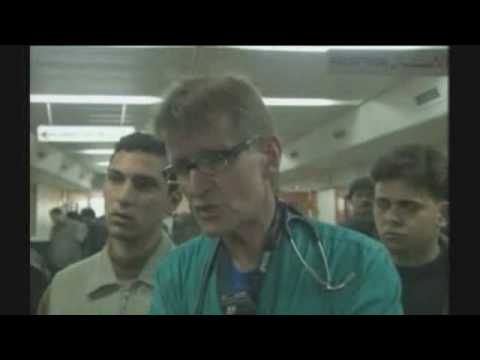
Dr. Mads Gilbert has described his time in the region as the most horrific and terrible thing he had ever witnessed. He co-authored the book “Eyes in Gaza” with his colleague, Dr. Erik Fosse, and embarked on a 16-campus North American tour in January and February of 2010.  Here in Toronto, he spoke at Ryerson University to a packed room of eagerly attentive eyes and ears.

He began by introducing himself and giving us some background on his history, qualifications, and professional life. He’s a very interesting man; having spent over 30 years doing solidarity work with Palestinians, he has served as a doctor during numerous periods in Occupied Palestine and Lebanon. He is also quite a controversial figure in the medical profession due to his strong position on merging medical and political issues. On being a doctor as well as a politician, Gilbert has said the two roles are indistinguishable, and that “there is little in medicine that isn’t politics”.

Gilbert’s presentation was unlike any I’ve ever seen either on the Gaza assault in particular, or on Palestine in general. He warned us beforehand of the graphic images he would be displaying; but unlike other presentations where graphic images are used purely for shock value, Dr. Gilbert uses them to tell a story, making sure to provide us with background on the victims’ lives, “introducing” us to them, giving them a name and human value. This took away the shock value; all eyes were glued on the screen, no matter how horrific or appalling the scenes. These were people, young and old, with lives, families, futures, aspirations…All taken away in an instant, most times at the simple press of a button.

However, this presentation was not just another “horrible scenes of war” lecture. Gilbert’s political activism was clearly woven into his entire talk; never dismissing an opportunity to clarify his stance on the Palestine/Israel issue. At times, his words were shocking; not because of what he said, but because I’ve never heard a medical professional speak his mind so freely about anything political, let alone a topic as controversial (and for some, career-ending) as that of Palestine. It was quite refreshing to say the least.

He ended his presentation with a message to all of us to get involved with Palestine, and particularly to drive the BDS (Boycott, Divestment, Sanctions) movement to the forefront of the struggle for Palestinian liberation. This was exciting to hear because that is exactly the direction we are moving with regards to the newly-drafted Cairo Declaration which came out of our time in Cairo with the Gaza Freedom March. We will be contacting him with information on this, and asking for his endorsement in the near future.

Of course, no discussion on Palestine or Gaza is complete without some good old-fashioned debate (if you can call it that) in the audience. During the Q&A session, which was still surprisingly civil, an Israeli IDF medical professional who was deployed to the Gaza Strip during Operation Cast Lead stood up and voiced his dissatisfaction and frustration with many of the statements Dr. Gilbert expressed during his lecture, especially in regards to Israeli doctors during the assault. Gilbert was shedding light on the discrimination that takes place in Israeli hospitals when doctors give preference to Israeli patients over Palestinians, but the IDF doctor took it personally and insisted that he always did his duty on the ground and treated all casualties as is morally required of any medical professional.

When someone brought up the fact that those “casualties” need not exist in the first place and raised the issue of the blatantly disproportionate figures, including civilian casualties, this IDF doctor’s response was that, “there’s always a large difference between Israeli and Palestinian deaths” during wars and the numbers are usually at least 100 to 1. I don’t need to tell you what happened after that, but let’s just say that after the talk was over, our little IDF friend was bombarded with questions, arguments, and debates for probably another 30-40 minutes. I didn’t stay and watch…

All in all, it was the best lecture/presentation I’ve seen in a very long time and I can’t stop telling people to go see it if he’s coming to a city near you. Most locations are across Canada, but Chicago, New York, and New Jersey are also hosting him in the coming weeks. For more information on dates and locations, visit: SPHR’s Event Page.

Filed Under: Palestine Tagged With: bds, gaza, israel, operation cast lead, Palestine, siege, toronto, war

“How to protest” from Al-Ahram Weekly

January 11, 2010 By Anonymous 6 Comments


The Egyptian newspaper Al-Ahram Weekly has a remarkable editorial titled “How to Protest” about the effects of the Gaza Freedom March and the events that unfolded in Cairo after the Egyptian government refused to allow 1362 international delegates to go to Gaza. Please substitute “internationals” for “Europeans” as our delegates represented 44 countries.

http://weekly.ahram.org.eg/2010/980/op4.htm

How to Protest
By Salama A Salama

European protesters took over our streets last week. In a show of solidarity with Gaza’s inhabitants and to protest against all sorts of injustices and blockades, European demonstrators marched through our streets, picketed our public squares and told us what they thought of the wall we’re building on Gaza’s borders.

Several hundred protesters came from 42 European countries to take part in pro-Gaza protests. So what did we do? We sent our security forces to contain them. We also prevented them from going to Gaza. Interestingly, the protesters refused to be intimidated. Instead, they picketed the French Embassy, they marched around the Giza Zoo, and they even stood guard at the famous steps of the Press Syndicate.

Curiously enough, the police did not prevent them from demonstrating in front of the Israeli Embassy. But clashes took place, and in some instances the Europeans had a taste of what Egyptians regularly experience at the hands of the police and their karate- trained auxiliaries.

During the past few days, Egyptians had proof that our police can act humanely, but only with foreigners. In front of the French Embassy, I saw a foreign man standing alone, surrounded by three circles of policemen. He was carrying a picket sign, but the police refrained from harming him in any way.

The Europeans came all the way to express their views, peacefully and orderly. In doing so, they gave us a rare glimpse into the working of peaceful resistance. And they stood for what they believe in. They vented their anger at a policy of blockade into which some Arab countries have become actively involved, either out of fear or desire to placate the Israelis.

The demonstrators slept in the streets and the squares. They occasionally obstructed traffic. And they sent to the Egyptians, Arabs, and the world a clear message, one which television stations relayed without delay across the world.

In this country, we don’t have a culture of protest. In this country, protest is treated as an act of sabotage, as a challenge to law and order. This is why we missed a rare opportunity to expose Israel’s crimes. How hard would it have been to let the European demonstrators walk into Gaza? Why did we fail to give them the chance to come face to face with an Arab nation living under occupation?

In Egypt, we don’t know how to encourage protest marches against Israel. But we know how to come up with lame excuses for building a controversial wall on our borders with Israel. Are we really worried about our own security, or are we protecting Israel?

In this country, it is wrong to protest. It is even wrong to be different. This is why our government gets so angry when opposition parliamentarians demand an explanation for the wall. Even in a parliament that prides itself on being a leader of all Arab parliaments, the opposition is demonised and abused for asking the right questions.

Worse still, our Islamic Research Council found itself pressured into issuing a statement in support of the wall. You would think that Sharia has nothing to do with security walls, but no. Our leading clergymen have decided to call anyone who opposes the wall an apostate. Don’t ask me why.

Many may ask what’s the point of it all. Did the Europeans achieve anything by marching in our streets? If you ask me, they achieved a lot. For starters, they sounded the alarm bells for the entire world, which is more than what our governments and nations have done so far. The protesters not only put Israeli actions on the line, but also underlined our own failings.

Filed Under: Gaza Freedom March, Politics Tagged With: blockade, egypt, gaza, gaza freedom march, israel, march, Palestine, protest, rafah, rally, siege, wall

Photos from the Gaza Freedom March

January 10, 2010 By Anonymous 3 Comments

[album id=3 template=extend]

Filed Under: Gaza Freedom March Tagged With: blockade, gaza, gaza freedom march, israel, march, Palestine, protest, pyramids, rafah, rally, siege, wall

Democracy Now! covers the Gaza Freedom March (VIDEO)

January 8, 2010 By Anonymous Leave a Comment


Check out Democracy Now!‘s  amazing coverage of the Gaza Freedom March in Cairo!

In Egypt, hundreds of solidarity activists from around the world are being prevented by the Egyptian government from entering Gaza. Dubbed the Gaza Freedom March, organizers were planning to cross the border last Sunday to commemorate the first anniversary of Israel’s assault on Gaza that killed 1,400 Palestinians and thirteen Israelis. We get a report.


Filed Under: Gaza Freedom March Tagged With: egypt, gaza, gaza freedom march, israel, march, Palestine, protest, rafah, rally, siege

Denied Entry into Jerusalem

January 5, 2010 By Anonymous Leave a Comment


jerusalem_soldiers

Our last day in Cairo was the 3rd of January. Our original plan was to fly to Amman then cross over into Jerusalem and spend a couple days there before heading back to Amman on the 6th to fly back to Canada. Our main goal was to visit and pray in Masjid Al-Aqsa. After everything that happened in Cairo, we left Cairo with the intention to just find the earliest flight out of Amman and get home as quickly as possible, completely bypassing our plans for Jerusalem.

Once we arrived in Amman and realized that all flights were overbooked, we decided on a whim to just go ahead and try to get to Jerusalem anyways. We took a taxi to the King Hussein bridge (about $30 JD). Once at the bridge entrance, we gave our passports to the departures clerk who then told us to get on the charter bus. We got our passports back on the bus with a white stamped paper tucked inside. We paid for our luggage/bus fare ($8 JD) and were on our way. The bus went through a couple checkpoints, one of which someone came on the bus and collected those white stamped papers. The bus then finally made it to the Allenby Terminal where we and our luggage were unloaded from the bus. The baggage clerk took our luggage and put a white sticker on our passports. Then a window clerk looked at our passports and put a red sticker on the back.

After all this, we were finally inside the terminal and went through the security check. The clerk held onto our passports and motioned us off to the side and told us to wait a few minutes for questioning. There were a few other people waiting as well and they said this was normal if you had recently been to other areas in the middle east. After about 2 minutes, we were taken into individual questioning: who we are, where we just came from, why we were there, how come we came through Amman (and not another crossing), how long we were staying, if we planned to visit any other areas, etc. After about 10 minutes of questioning, they gave us back our passports and told us to wait in line to get our entry visas. Five minutes later, we were at the visa window and were asked some more redundant questions. The clerk asked if she could stamp our passport and we asked her to stamp a separate paper instead.

She then gave us a tourism information sheet to fill out. It had basic questions which mirrored those that were asked of us earlier. When they asked where we were coming from, we wrote “Egypt” and when asked what we were there for, we wrote “tourism”. We didn’t disclose the fact that we were there for GFM because that whole plan ended up not happening. After we turned in the form, we were told to wait in the waiting area for further questioning.

It was probably about an hour and a half before we heard anything. First Basem was called in for questioning. The agent seemed really hung up on the fact that we looked completely different from our passport pictures; I now wear the hijab and Basem now wears his beard long and a kufi on his head. Basem was asked about our religiosity and what happened that changed our level of spirituality. After this, Basem came back and said that I did not have to go in.

We waited for another two hours before we heard anything. Finally, they asked us to come into the next waiting area with our bags. We brought our bags into the baggage check area and were told to leave them there for further security checks. We waited just outside this area and had a clear view of what they were doing inside. We saw them completely emptying our bags and checking EVERYTHING inside. Anything that could have been opened and dumped was opened and dumped. They didn’t just search our bags, they ransacked all of our belongings…it was quite the sight!

We again waited for another hour before they asked me to come in for some questioning. By this time they had found our Gaza Freedom March t-shirts and were aware of our activities in Egypt. The agent, Shabak, asked me again why were in Egypt and I told him matter-of-factly that we were there for one reason, which didn’t happen, and were forced to stay in Cairo for 5 days for tourism purposes. He said that we lied by saying we were just there for tourism and should have disclosed the GFM information. I clarified again that GFM didn’t happen and we stated tourism because that is what we put on our Egypt visas as well. I also explained to him that our Jerusalem plans were completely unrelated to the Cairo visit and that we were here on our own personal spiritual journey which we’d been planning for a long time. He said ok, and that now this process would take “an awful long time”, which I accepted and went back to the waiting area.

During all this time, I must say the agents were all very kind and polite to us; they offered us an area to pray when we asked them, they offered us water, they constantly checked on us to make sure we were alright, and one younger person came up to us to ask why we were ther for so long and expressed his condolences for the fact that we were still there after nearly 7 hours.

After about 7 hours of being at the entrance terminal, Shabak asked us to come back into the baggage check area and repack all of our stuff into our bags. After that, they told us that we could have all our stuff back, that there would be no problems, but that that we would be transferred over to the border police who would then make the decision of whether or not to let us into Israel. Just 10 minutes later, we were told to go back to the previous waiting area, where the border police would cooridinate a bus to take us back to the Amman-side of the King Hussein bridge. This was obviously embarrassing since we were the only ones going backwards in the through the terminal. Our passports, which had already been stamped with a visa, were then marked up in a red ink stamp “ENTRY DENIED from Allenby Crossing” — fairly large and obvious. We waited outside for the bus that would take us back to Amman. We asked if this meant we would never be allowed back into Israel; we didn’t get a conclusive answer, but the general idea was most likely NO.

Waiting for the bus, then on the ride back to Amman, it all started to hit me that I may very well never get the chance to enter Jerusalem or pray in Masjid Al-Aqsa. It was very depressing and saddening. I felt personally deprived of Jerusalem and the holy land. Not only were we not allowed to enter Gaza through Rafah, but we were now being denied entry into Jerusalem through Israel. All I could think about was how stupid we were for not disclosing the GFM information on our information form. Why we didn’t completely rid our bags of GFM paraphernelia. Why we didn’t just tell the truth! But then after my head cleared a little, I realized something. In retrospect, remembering everything that happened and the way that it happened made me realize that we were probably never going to be allowed in anyways.

From the second they saw our passports at the first indoor security check, they immediately held onto our passports. I think this was not only because we were just in Cairo, but also the dates we were in Cairo were the exact dates of the GFM trip, which they are obviously well aware of. Also, looking back at all the questions they asked us, it became very clear that not only did they know that we were part of GFM, but they were trying to fish that information out of us. They knew exactly who we were, why we were in Cairo, and that we didn’t get into Gaza as we’d hoped. So now we were trying to enter into Jerusalem, looking completely different from our passport pictures; they thought we had disguised ourselves to look like we were religious so they would let us into Jerusalem. I think they thought we wanted to attempt to get to Gaza through Jerusalem or the West Bank, which is completely ludicrous but I understand where they were coming from. After all we did in Cairo, they obviously didn’t want any trouble in Jerusalem or anywhere in Israel. The troubles and challanges GFM caused the Egyptian government was all over the news by then!

After my initial depression, then completely understanding exactly what happened and why, now we’re at a place where we both feel personally and spiritually deprived of Jerusalem, Palestine, and the Holy Land as a whole. Before this, we both were very passionate about the Palestinian cause, but after being denied entry into both Gaza and the West Bank, we have a much more personal passion for all of this. We now feel like the numerous Palestinians all over the world who cannot even enter back into their own homes! It’s definitely a personal struggle now. It’s a positive thing though because it gives us that real fire in our hearts to motivate us and push us even harder to fight for this issue of liberating the Holy Land, insha’Allah.

The many things we did in Cairo and the many more that will come out of our meetings in Cairo will have much more purpose and substance for us personally, and we can’t wait to get started on all of those initiatives. It would be an understatement if we said that this trip didn’t go as planned! Not one thing went as planned and our trip took on a whole new direction, meaning, and purpose! We found out that Gaza is not only under siege by Israel, but also Egypt! We learned that before we liberate Gaza from the Israelis, we must raise a revolution in Egypt to allow us to break the siege from that side first.

We learned so much about the Egyptian mind-set and just how much work there is to be done in Egypt, but we also come away from this trip with a heightened sense of accomplishment. We really riled up emotions and opened up hearts and minds in Egypt. We planted little seeds in everyone’s consciousness about the Palesinian cause and the fact that so many internationals were willing to converge on a foreign country and rally and protest against that country’s government and policies. So many locals voiced their support of what we were doing and were so happy to see that foreigners could now see the plight of the Egyptian people as well.

El horriya li Ghaza, el horriya li Masr! El shab el masry ma’ana!

(Freedom for Gaza, freedom for Egypt! The Egyptian people are with us!)


Filed Under: Gaza Freedom March, Spirtual Tagged With: gaza freedom march, holy land, israel, jerusalem, Palestine

Gaza Freedom Marchers issue the “Cairo Declaration” to end Israeli Apartheid

January 1, 2010 By Anonymous Leave a Comment

(Cairo) Gaza Freedom Marchers approved today a declaration aimed at accelerating the global campaign for Boycott, Divestment and Sanctions (BDS) against Israeli Apartheid.

Roughly 1400 activists from 43 countries converged in Cairo on their way to Gaza to join with Palestinians marching to break Israel’s illegal siege. They were prevented from entering Gaza by the Egyptian authorities.

As a result, the Freedom Marchers remained in Cairo. They staged a series of nonviolent actions aimed at pressuring the international community to end the siege as one step in the larger struggle to secure justice for Palestinians throughout historic Palestine.

This declaration arose from those actions:


End Israeli Apartheid

Cairo Declaration

January 1, 2010

We, international delegates meeting in Cairo during the Gaza Freedom March 2009 in collective response to an initiative from the South African delegation, state:

In view of:

o Israel’s ongoing collective punishment of Palestinians through the illegal occupation and siege of Gaza;

o the illegal occupation of the West Bank, including East Jerusalem, and the continued construction of the illegal Apartheid Wall and settlements;

o the new Wall under construction by Egypt and the US which will tighten even further the siege of Gaza;

o the contempt for Palestinian democracy shown by Israel, the US, Canada, the EU and others after the Palestinian elections of 2006;

o the war crimes committed by Israel during the invasion of Gaza one year ago;

o the continuing discrimination and repression faced by Palestinians within Israel;

o and the continuing exile of millions of Palestinian refugees;

o all of which oppressive acts are based ultimately on the Zionist ideology which underpins Israel;

o in the knowledge that our own governments have given Israel direct economic, financial, military and diplomatic support and allowed it to behave with impunity;

o and mindful of the United Nations Declaration on the Rights of Indigenous People (2007)

We reaffirm our commitment to:

Palestinian Self-Determination

Ending the Occupation

Equal Rights for All within historic Palestine

The full Right of Return for Palestinian refugees

We therefore reaffirm our commitment to the United Palestinian call of July 2005 for Boycott, Divestment and Sanctions (BDS) to compel Israel to comply with international law.

To that end, we call for and wish to help initiate a global mass, democratic anti-apartheid movement to work in full consultation with Palestinian civil society to implement the Palestinian call for BDS.

Mindful of the many strong similarities between apartheid Israel and the former apartheid regime in South Africa, we propose:

1) An international speaking tour in the first 6 months of 2010 by Palestinian and South African trade unionists and civil society activists, to be joined by trade unionists and activists committed to this programme within the countries toured, to take mass education on BDS directly to the trade union membership and wider public internationally;

2) Participation in the Israeli Apartheid Week in March 2010;

3) A systematic unified approach to the boycott of Israeli products, involving consumers, workers and their unions in the retail, warehousing, and transportation sectors;

4) Developing the Academic, Cultural and Sports boycott;

5) Campaigns to encourage divestment of trade union and other pension funds from companies directly implicated in the Occupation and/or the Israeli military industries;

6) Legal actions targeting the external recruitment of soldiers to serve in the Israeli military, and the prosecution of Israeli government war criminals; coordination of Citizen’s Arrest Bureaux to identify, campaign and seek to prosecute Israeli war criminals; support for the Goldstone Report and the implementation of its recommendations;

7) Campaigns against charitable status of the Jewish National Fund (JNF).

We appeal to organisations and individuals committed to this declaration to sign it and work with us to make it a reality.

To sign the declaration, please visit: http://cairodeclaration.org/sign

Signed by:

(* Affiliation for identification purposes only.)

1. Hedy Epstein, Holocaust Survivor/ Women in Black*, USA

2. Nomthandazo Sikiti, Nehawu, Congress of South African Trade Unions (COSATU), Affiliate International Officer*, South Africa

3. Zico Tamela, Satawu, Congress of South African Trade Unions (COSATU) Affiliate International Officer*, South Africa

4. Hlokoza Motau, Numsa, Congress of South African Trade Unions (COSATU) Affiliate International Officer*, South Africa

5. George Mahlangu, Congress of South African Trade Unions (COSATU) Campaigns Coordinator*, South Africa

6. Crystal Dicks, Congress of South African Trade Unions (COSATU) Education Secretary*, South Africa

7. Savera Kalideen, SA Palestinian Solidarity Committee*, South Africa

8. Suzanne Hotz, SA Palestinian Solidarity Group*, South Africa

9. Shehnaaz Wadee, SA Palestinian Solidarity Alliance*, South Africa

10. Haroon Wadee, SA Palestinian Solidarity Alliance*, South Africa

11. Sayeed Dhansey, South Africa

12. Faiza Desai, SA Palestinian Solidarity Alliance*, South Africa

13. Ali Abunimah, Electronic Intifada*, USA

14. Hilary Minch, Ireland Palestine Solidarity Committee*, Ireland

15. Anthony Loewenstein, Australia

16. Sam Perlo-Freeman, United Kingdom

17. Julie Moentk, Pax Christi*, USA

18. Ulf Fogelström, Sweden

19. Ann Polivka, Chico Peace and Justice Center*, USA

20. Mark Johnson, Fellowship of Reconciliation*, USA

21. Elfi Padovan, Munich Peace Committee*/Die Linke*, Germany

22. Elizabeth Barger, Peace Roots Alliance*/Plenty I*, USA

23. Sarah Roche-Mahdi, CodePink*, USA

24. Svetlana Gesheva-Anar, Bulgaria

25. Cristina Ruiz Cortina, Al Quds-Malaga*, Spain

26. Rachel Wyon, Boston Gaza Freedom March*, USA

27. Mary Hughes-Thompson, Women in Black*, USA

28. David Letwin, International Jewish Anti-Zionist Network (IJAN)*, USA

29. Jean Athey, Peace Action Montgomery*, USA

30. Gael Murphy, Gaza Freedom March*/CodePink*, USA

31. Thomas McAfee, Journalist/PC*, USA

32. Jean Louis Faure, International Jewish Anti-Zionist Network (IJAN)*, France

33. Timothy A King, Christians for Peace and Justice in the Middle East*, USA

34. Gail Chalbi, Palestine/Israel Justice Project of the Minnesota United Methodist Church*, USA

35. Ouahib Chalbi, Palestine/Israel Justice Project of the Minnesota United Methodist Church*, USA

36. Greg Dropkin, Liverpool Friends of Palestine*, England

37. Felice Gelman, Wespac Peace and Justice New York*/Gaza Freedom March*, USA

38. Ron Witton, Australian Academic Union*, Australia

39. Hayley Wallace, Palestine Solidarity Committee*, USA

40. Norma Turner, Manchester Palestine Solidarity Campaign*, England

41. Paula Abrams-Hourani, Women in Black (Vienna)*/ Jewish Voice for Just Peace in the Middle East*, Austria

42. Mateo Bernal, Industrial Workers of the World*, USA

43. Mary Mattieu, Collectif Urgence Palestine*, Switzerland

44. Agneta Zuppinger, Collectif Urgence Palestine*, Switzerland

45. Ashley Annis, People for Peace*, Canada

46. Peige Desgarlois, People for Peace*, Canada

47. Hannah Carter, Canadian Friends of Sabeel*, Canada

48. Laura Ashfield, Canadian Friends of Sabeel*, Canada

49. Iman Ghazal, People for Peace*, Canada

50. Filsam Farah, People for Peace*, Canada

51. Awa Allin, People for Peace*, Canada

52. Cleopatra McGovern, USA

53. Miranda Collet, Spain

54. Alison Phillips, Scotland

55. Nicholas Abramson, Middle East Crisis Response Network*/Jews Say No*, USA

56. Tarak Kauff, Middle East Crisis Response Network*/Veterans for Peace*, USA

57. Jesse Meisler-Abramson, USA

58. Hope Mariposa, USA

59. Ivesa Lübben. Bremer Netzwerk fur Gerechten Frieden in Nahost*, Germany

60. Sheila Finan, Mid-Hudson Council MERC*, USA

61. Joanne Lingle, Christians for Peace and Justice in the Middle East (CPJME)*, USA

62. Barbara Lubin, Middle East Children’s Alliance*, USA

63. Josie Shields-Stromsness, Middle East Children’s Alliance*, USA

64. Anna Keuchen, Germany

65. Judith Mahoney Pasternak, WRL* and Indypendent*, USA

66. Ellen Davidson, New York City Indymedia*, WRL*, Indypendent*, USA

67. Ina Kelleher, USA

68. Lee Gargagliano, International Jewish Anti-Zionist Network (Chicago)*, USA

69. Brad Taylor, OUT-FM*, USA

70. Helga Mankovitz, SPHR (Queen’s University)*, Canada

71. Mick Napier, Scottish Palestine Solidarity Campaign*, Scotland

72. Agnes Kueng, Paso Basel*, Switzerland

73. Anne Paxton, Voices of Palestine*, USA

74. Leila El Abtah, The Netherlands

75. Richard, Van der Wouden, The Netherlands

76. Rafiq A. Firis, P.K.R.*/Isra*, The Netherlands

77. Sandra Tamari, USA

78. Alice Azzouzi, Way to Jerusalem*, USA

79. J’Ann Schoonmaker Allen, USA

80. Ruth F. Hooke, Episcopalian Peace Fellowship*, USA

81. Jean E. Lee, Holy Land Awareness Action Task Group of United Church of Canada*, Canada

82. Delphine de Boutray, Association Thèâtre Cine*, France

83. Sylvia Schwarz, USA

84. Alexandra Safi, Germany

85. Abdullah Anar, Green Party – Turkey*, Turkey

86. Ted Auerbach, USA

87. Martha Hennessy, Catholic Worker*, USA

88. Louis Ultale, Interfaile Pace e Bene*, USA

89. Leila Zand, Fellowship of Reconciliation*, USA

90. Emma Grigore, CodePink*, USA

91. Sammer Abdelela, New York Community of Muslim Progressives*, USA

92. Sharat G. Lin, San Jose Peace and Justice Center*, USA

93. Katherine E. Sheetz, Free Gaza*, USA

94. Steve Greaves, Free Gaza*, USA

95. Trevor Baumgartner, Free Gaza*, USA

96. Hanan Tabbara, USA

97. Marina Barakatt, CodePink*, USA

98. Keren Bariyov, USA

99. Ursula Sagmeister, Women in Black – Vienna*, Austria

100. Ann Cunningham, Australia

101. Bill Perry, Delaware Valley Veterans for Peace*, USA

102. Terry Perry, Delaware Valley Veterans for Peace*, USA

103. Athena Viscusi, USA

104. Marco Viscusi, USA

105. Paki Wieland, Northampton Committee*, USA

106. Manijeh Saba, New York / New Jersey, USA

107. Ellen Graves, USA

108. Zoë Lawlor, Ireland – Palestine Solidarity Campaign*, Ireland

109. Miguel García Grassot, Al Quds – Málaga*, Spain

110. Ana Mamora Romero, ASPA-Asociacion Andaluza Solidaridad y Paz*, Spain

111. Ehab Lotayef, CJPP Canada*, Canada

112. David Heap, London Anti-War*, Canada

113. Adie Mormech, Free Gaza* / Action Palestine*, England

114. Aimee Shalan, UK

115. Liliane Cordova, International Jewish Anti-Zionist Network (IJAN)*, Spain

116. Priscilla Lynch, USA

117. Jenna Bitar, USA

118. Deborah Mardon, USA

119. Becky Thompson, USA

120. Diane Hereford, USA

121. David Heap, People for Peace London*, Canada

122. Donah Abdulla, Solidarity for Palestinian Human Rights*, Canada

123. Wendy Goldsmith, People for Peace London*, Canada

124. Abdu Mihirig, Solidarity for Palestinian Human Rights-UBC*, Canada

125. Saldibastami, Solidarity for Palestinian Human Rights-UBC*, Canada

126. Abdenahmane Bouaffad, CMF*, France

127. Feroze Mithiborwala, Awami Bharat*, India

128. John Dear, Pax Christi*, USA

129. Ziyaad Lunat, Portugal

130. Michael Letwin, New York City Labor Against the War (NYCLAW)

131. Labor For Palestine

132. Basem Emara & Sarah Mahmoud, Canada

Filed Under: Gaza Freedom March, Politics Tagged With: apartheid, blockade, boycott, divestment, gaza, gaza freedom march, israel, march, Palestine, protest, rafah, rally, sanctions, siege

  • « Go to Previous Page
  • Page 1
  • Page 2
  • Page 3
  • Page 4
  • Page 5
  • Page 6
  • Go to Next Page »

Primary Sidebar

Copyright © 2026 · Just One Reason · Log in